Paro is located in the western part of Bhutan neighbouring Thimphu and Haa Dzongkhag. Up until the establishment of Thimphu as the nation’s capital in 1962, Paro served as the primary cultural, economic, and political hub of the nation. Paro continues to serve as the country’s summer capital. It has an aviation landing strip and is connected to Phuntsholing on the Indian border by the Indo-Bhutan National Highway.
Tiger’s Nest Monastery
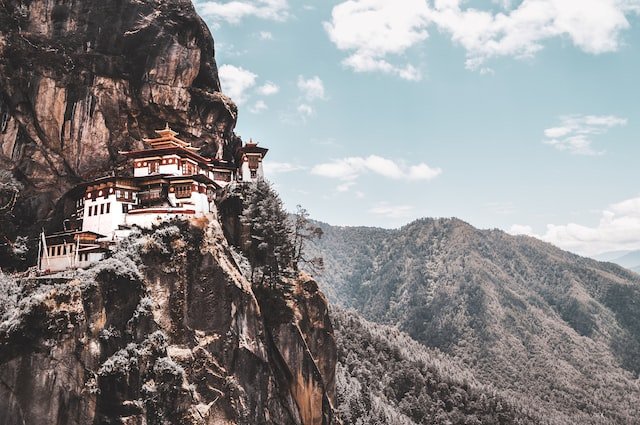
Paro Taktsang, also known as Tiger’s Nest or Taktsang Palphug Monastery, is a revered Buddhist holy place that is situated in Bhutan’s upper valley on a cliffside. This temple, which hangs from a precarious cliff 10,240 feet above the Paro valley and can only be reached by a difficult road, has come to symbolize Bhutan. It is one of the greatest sites to visit in Paro despite being difficult to get to because of its secluded position, which also makes it an attractive, distinctive, and unforgettable destination.
Its interior is much more magnificent because of the glistening lights, golden dome, and idols. The hall of a thousand Buddhas, which is carved out of rock, contains a sizable statue of a tiger.
Every structure has windows that provide a beautiful view, and the steps are cut out of the rocks and connect the buildings.
The prayer wheel, the temple’s major shrine, is rotated by the monks every morning at four in the morning to signal the start of a new day. In the Paro valley, a celebration called Tsechu is held in honor of Padmasambhava in March or April.
Airport View Point
Airport View Point is the first destination that the majority of visitors visit after arriving at the Paro International Airport since it is regarded as one of the greatest locations to visit in Paro to take in panoramic views of the lush green Paro Valley.
The Paro International Airport, which is ranked among the top ten airports, is constructed between the tall, gorgeous mountains that are covered in a deep green hue.
There is therefore no surprise that the outlook will knock you out by providing you with the nicest vistas available.
Rinpung Dzong
The Rinpung Dzong monastery, another historic monastery in Paro, is a must-see if you’re there to do some tourism.
You may capture some breath-taking photos from its perch on the edge of a hill overlooking the lovely valley that is flanked on all sides by sweeping green hills.
The monastery, whose name translates as “Fortress atop a Heap of Jewels,” as well as the building itself, have historically been essential in defending Bhutan against outside incursions.
When you visit the Dzong today, you may see some incredible architecture and works of art that have lasted the test of time.
Drukgyal Dzong
Due to its illustrious past and current reputation, Drukgyel is among the most fascinating destinations to visit in Paro.
One of the oldest monasteries in the region, it has endured and survived for everyone to see today despite being destroyed by a devastating fire disaster in the 1950s.
In addition to the numerous already existing paintings and frescoes, the fort has been repaired and refurbished.
From the monastery’s peak, visitors may enjoy a stunning view of the neighboring Chomolhari mountains.
Tamchoe Monastery
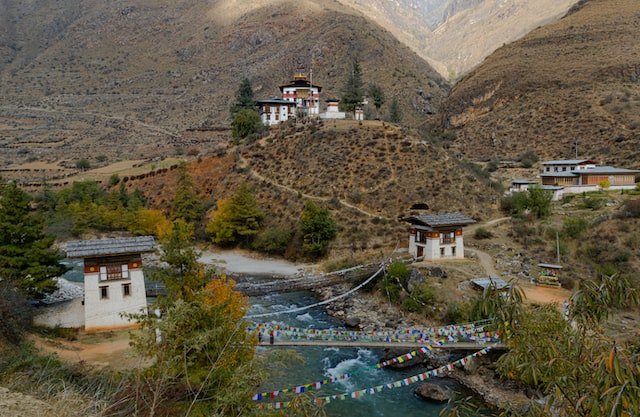
One of the most iconic tourist destinations in Paro is without a doubt the Tamchoe Monastery. Locals name the monastery Tachog Lhakhang, which translates to “temple of the hill of the good horse.” The temple is situated along the road that links Paro with Thimpu, the country’s capital.
The temple was constructed in 1420 by Thangtong Gyalpo.
The inspiration for building the temple is thought to have come from a vision of the Buddhist deity Avalokiteshvara appearing as a Balaha-an, or spiritual horse. The monastery offers a stunning perspective of the Paro Chhu and the surrounding valleys.